Ode’r de Saturday Afternoon… or Free at Last!
By: Lila Travis
I received a knock on my door today.
The vibrant and warm sun was illuminating the most beautiful of greens in all the plants surrounding my Potrero Hill front door. I found a man there – a neighbor I had never met before. Feng. He was tall, with a kind face and a worried look. A skunk, he said, with it’s head stuck in a mouse trap. Would I come help? Of course! I grabbed a towel and my grumpy son, Devlin, threw on my shoes, and we hurried out the door to follow Feng up through the Open Space to the back yard of Starr King Elementary School.
Starr King Elementary School is a harsh concrete and b
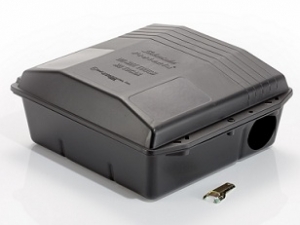 rick building, softened by rows of evergreen hedges and flower boxes. There, behind the hedges, pressed against the concrete foundation, was a long bushy tail, glistening black with a limp white stripe down the middle. Body tensed with effort, the enormous female skunk was twisting and turning in the dirt. Her head disappearing into the entrance of a black box rodent bait trap. You know, those little black boxes the size of shoe-boxes seen left around public places that the kids always loudly ask about and we response in a whisper, “Ooo that’s poison – stay away from those!”.
She had burrowed out a deep trench in the soil under her body, in her desperate struggle to extract herself from the box, with no success. Each day her struggle causing her throat and head to swell more and more inside the sharp, unforgiving plastic, making her escape less and less possible until death freed her. Her flailing claws dug the trench underneath her deeper and deeper, revealing shrub roots that wrapped around her to complicate and confine her movements even further.
How did this happen? How did her head even fit in there? My mind flashed to the Yoplait yogurt container controversy from the 1970s. Yoplait yogurt containers are perfectly shaped for the shovel-shaped skunk head to fit in but not get out. Actually, when the Yoplait yogurt company was asked to change the shape of their containers to end the years of wildlife fatalities due to getting stuck inside their plastic tubs, they declined, stating that their unique shape set them apart from their competition and that consumers gravitated to their interestingly shaped yogurt cups, so they would not relent and alter their positive product identification packaging even if it was a hazard to animals. After 20 years of fatal skunk and other wildlife incidents, and public outcry, Yoplait finally agreed to add a printed warning to the cups urging consumers to “crush the cup” before discarding it. But the incidents of wildlife deaths from being trapped in Yoplait yogurt containers continue to rise even today, 37 years after their invention. (to help, you can sign this petition: https://www.change.org/p/for-35-years-yoplait-cups-have-been-killing-wildlife ) .
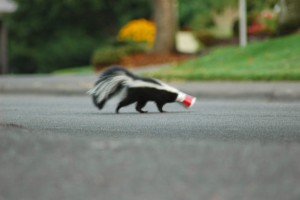
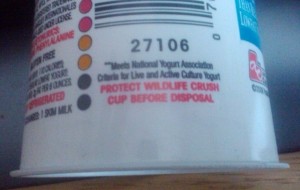
Here it was playing out in front of me all over again. Why did this skunk put her head in this box of poison? Did she see a mouse run out of the box and, thinking there might be more mice inside, decided to go in for a closer look? (Skunks are natural rodent controllers by eating mice and rats) Thankfully, due to the design of the box, there was none of the poison within reach of her trapped nose and mouth, so I was hopeful that if she could be extracted, she could survive the experience unscathed, provided she had not ingested any poisoned mice, putting herself at risk for a secondary rodent poisoning death.
Throughout California, the use of poison baits stations to control rodents has resulted in the death of thousands of wild animals and pets each year. The targeted mouse or rat eats the poison from the trap, but the poison doesn’t kill them immediately. They have plenty of time to run around outside, eat more poison bait, get weakened from internal bleeding caused by the poison, and get caught by an owl, hawk, pet cat, or skunk, before they die. The unfortunate predator doesn’t realize they are eating a poisoned dinner and thus, the poisoning is passed along to untargeted victims. Using rodent bait is no different then leaving poisoned meatballs on the street for local pets and wildlife to find. http://www.sfgate.com/bayarea/article/Poisoned-meatballs-again-threaten-dogs-in-San-5259552.php Secondary rodent poisoning does not discriminate between animals that are beautiful or endangered or hated or pesty or awe-inspiring. Since 1994, the California Department of Fish & Wildlife’s Wildlife Investigation Laboratory has tested and confirmed hundreds of cases of secondary wildlife poisoning from anticoagulant rodent baits, including: coyote, gray fox, red fox, San Joaquin kit fox (endangered), fishers (endangered), raccoons, squirrels, bobcats, mountain lions, black bears, kangaroo rats (endangered), bald eagles (endangered), golden eagles, Canada geese, great-horned owls, barn owls, red-shouldered hawks, red-tailed hawks, Cooper’s hawks, turkey vultures and wild turkeys. A much more effective rodent control program uses exclusion techniques (such as sealing rodent entrances to your home) and sanitation (removing rodent habitat such as ivy or wood piles) and animal removal, when necessary. Programs like the Hungry Owl Project ( http://www.hungryowl.org/ ) actually encourage owls to breed and populate areas where there are problems with mice, providing a natural rodent control that does not harm unintended victims, with the added bonus of occasional heart-stopping gasps of joy when a glimpse of the owls occur, and with no dangers posed to our friendly, long-suffering skunk lady in a ditch with a rodent bait box around her neck.
I had watched her struggle long enough. It was time to help. I was slightly alarmed that she was so large – I knew that once I touched her, my bath-sized towel would be little protection against her blind, terrified lashing out with the only defense mechanism available to her; her chemical gas cloud designed to swell mucosa and cause even the coldest individual to weep openly. I took one last breath of clean fresh air, then moved into position. Placing my towel around her body and tucking her tail up against her, with the hope that if she sprayed, it would be into the towel. I proceeded to begin the slow process of pulling her head bodily out of the hole in the black box of death. It didn’t help matters that the box had been, for ridiculously unnecessary security, chained to the concrete foundation of the building so I could only lift it up about 4 inches.
The big mama skunk’s struggle intensified as I methodically worked her swollen neck and head out of the tiny hole. There was no other option, since the plastic was so thick, even Feng’s knife was unable to cut it away. The skunk was terrified – not knowing if my intention was to eat her and not caring. She sprayed once, twice, I wrapped the stinky towel tighter around her and kept on working, my fingers staining yellow from the chemical reaction taking place in the towel. She uttered a few cries as her eye slowly came into view, then more cries as her swollen neck came free, and then her nose – she was out!

I covered her with the rest of the towel and backed off, ignoring the burning rubber smell inside my nose, mouth and eyes. She sat there, her head peaking out at us from under the towel, as she realized she was free and able to go on her merry way once again. She took a few more minutes to recover, then loped off through the hedges towards the open space.
“There she goes!” exclaimed Devlin happily, as she crossed the tiny alley and disappeared into the tall grasses of Starr King Open Space. I was pleased at her fast movements and apparently uninjured demeanor. She rushed across the sunlit field, back into her familiar territory of shadows and grubs and rotting stumps along the edge of the small park.


Feng, Devlin, who was in a much better mood now, and I gathered up our equipment and headed back home across the Open Space, smiling to ourselves at the skunk’s elation at being free again. Before disappearing back into my home to drown myself in Baking Soda, Peroxide, and dawn detergent, I turned to the second hero in this story, after the brave skunk, and told him a simple truth, “ Most people wouldn’t have bothered. Thank you.”
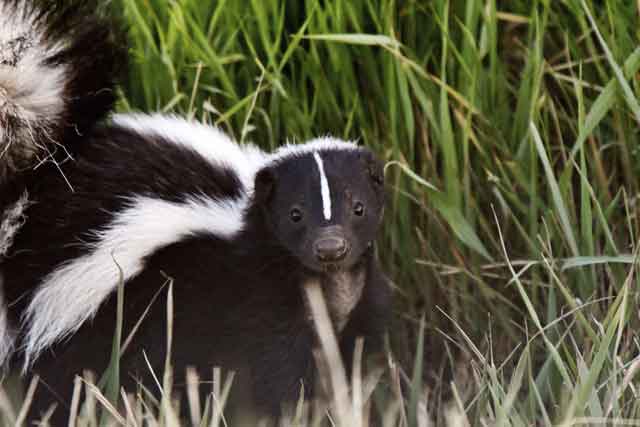
Excerpt From: The Chemistry of Skunk Spray from i09.com
“The organic compounds that make skunk spray smell are also found in garlic and onions. They’re called thiols, and they’re very simple. Just hook one sulfur atom to one hydrogen atom.
The two leg-breakers in the family of chemicals that a skunk sprays are (E)-2-butene-1-thiol and 3-methyl-1-butanethiol. These are chains of carbon and hydrogen with the sulfur and hydrogen thiol group attached to one end. They’re volatile, which means they disperse easily in the air, and they’re easily picked up by the human nose. The back-up squad of skunk spray consists of thioacetates, other groupings of carbon and hydrogen that are, at first, not particularly smelly. When water hits them, it rearranges them into more potent configurations. A dog – or human – that’s been sprayed by a skunk will sometimes get smellier after being bathed in water. These compounds also linger, so when an area of a house that’s been sprayed by a skunk gets rained on, we get a delayed reminder never to make a skunk mad.
How to get the stench out? Tomato juice won’t do it. It’s just a strong smell that attempts to cover up the smell of skunk. What you need is a chemical that will change the composition of the thiol group. Fortunately, baking soda and hydrogen peroxide are will do the job. They are oxidizing agents, meaning they will attach oxygen atoms to the sulfur atom in the thiol pairing, and take away its ability to stink.”
________________________________________________________________
Recipe for Neutralizing Skunk Spray:
- 1 quart of 3-percent hydrogen peroxide (available at your local pharmacy)
- 1/4 cup baking soda
- 1 teaspoon liquid dishwashing soap (DAWN works best)
________________________________________________________________________
Did you know?
- Skunks are extremely nearsighted and can only see clearing about 12 inches in front of them?
- Once a skunk sprays they are defense-less for up to 2 days. They do not want to use their spray unless their lives depend on it so avoid startling a skunk into spraying by making noise and letting them know you are there. Remember they do not see well!
- Skunks only spray for 2 reasons: When they perceive their lives are threatened. OR During mating season. (See Below)
From United States Humane Society Website:
“February through March is mating season for striped Skunks and that translates into “skunk smell.”
The stink occurs when males try to court females who may not be “in the mood.” When that happens, female skunks generate an aroma to repel their rejected suitors. Fortunately, skunk romance only lasts a short time.
Skunks are gentle, non-aggressive creatures who have wrongly earned a bad reputation because of that pungent odor. Their diet of grubs, insects, mice, and baby rats is actually beneficial, but skunks still go unappreciated.
As for being sprayed by a skunk, you may not realize just how difficult it is to get sprayed. When alarmed, skunks give a warning by stamping their front feet. If you take heed of that warning, they won’t spray.”
_________________________________________________________________________
For Solutions to Problems with Skunks, please visit: http://yuwr.org/faqs/skunk-problems/
_________________________________________________________________________
MOST PHOTOS COURTESY OF THE INTERNET, EXCEPT THE TWO OF ACTUAL SKUNK FROM STORY